The Result: Your UK Score
At uk.trufl.ai, every product is rated with care, objectivity, and up-to-date market insights. Our rating is a combination of four carefully tested quality signals, supported by advanced AI and data science.
Turnbuckles are ingeniously simple yet incredibly effective pieces of hardware designed for adjusting the tension or length of ropes, cables, tie rods, and other tensioning systems. They consist of a metal frame, often called the body, with threaded ends that accept threaded eye bolts, hooks, or jaws. By rotating the body, the attached components are either drawn closer together or pushed further apart, allowing for precise tension adjustments. This capability makes turnbuckles indispensable in a wide range of applications where controlled tension is critical.
The beauty of turnbuckles lies in their versatility and ease of use. They offer a mechanical advantage, allowing for significant tension to be applied with relatively little effort. This makes them ideal for situations where manual adjustment is necessary or preferred. Furthermore, turnbuckles are available in a variety of materials, sizes, and configurations, ensuring that there's a suitable option for virtually any application, from light-duty tasks to heavy-duty industrial projects. Their robust construction and straightforward design contribute to their long lifespan and reliable performance.
What truly sets turnbuckles apart is their ability to provide controlled and adjustable tension. Unlike fixed-length fasteners, turnbuckles allow for fine-tuning, compensating for stretch, settling, or other factors that can affect tension over time. This adjustability is crucial in maintaining the integrity and safety of structures and systems. Whether it's securing a sailboat mast, tensioning a fence, or stabilizing a building, turnbuckles play a vital role in ensuring that everything stays properly aligned and under the correct amount of tension.
The exact origins of the turnbuckle are somewhat obscure, but their use can be traced back to the 18th century, primarily in nautical applications for adjusting rigging on sailing ships.
Early turnbuckles were likely hand-forged and relatively simple in design, but they provided a crucial method for maintaining the tension of sails and supporting masts.
As technology advanced, turnbuckles evolved with improved materials and manufacturing processes. The introduction of machine threading and mass production made them more readily available and affordable.
In the 20th century, turnbuckles found applications beyond maritime uses, becoming essential components in construction, engineering, and various industrial settings.
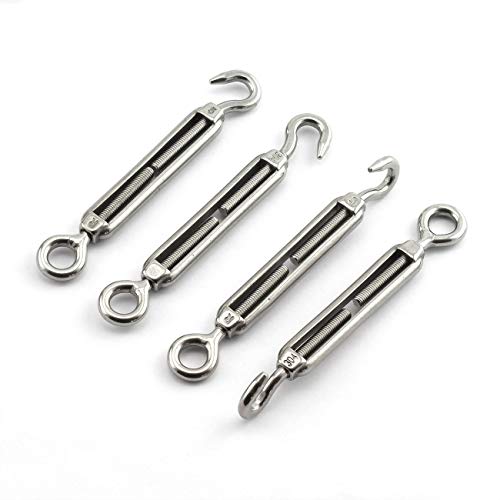

Eye and Eye Turnbuckles: Feature an eye at each end, suitable for connecting to shackles or other looped hardware.
Hook and Eye Turnbuckles: Have a hook at one end and an eye at the other, allowing for quick attachment and detachment.
Jaw and Jaw Turnbuckles: Utilize jaws or clevises at each end, providing a secure and robust connection.
Stub End Turnbuckles: Designed to be welded directly to other components for a permanent connection.
Pipe Turnbuckles: Used for tensioning pipes.

Tensioning cables and ropes: Used in rigging, fencing, and suspension systems to apply and maintain the desired tension.
Adjusting length: Compensate for stretch, settling, or manufacturing tolerances in structures and systems.
Stabilizing structures: Provide support and prevent movement in buildings, bridges, and other constructions.
Securing loads: Used in transportation and material handling to secure cargo and prevent shifting.
Marine applications: Adjusting rigging on sailboats and other vessels.

Sailors and boat owners: For adjusting rigging and maintaining the tension of sails.
Construction workers and engineers: For stabilizing structures and tensioning cables in buildings and bridges.
Landscapers and fence installers: For tensioning fences and creating secure enclosures.
Truckers and transportation professionals: For securing loads and preventing shifting during transport.
DIY enthusiasts and homeowners: For various projects around the house, such as hanging lights or securing trellises.
HVAC professionals: For tensioning pipes.